An Initiative of Tennessee's Faith-Based and Community Initiative
Men and women in prison are preparing to come home. They need you.
The Volunteer Mentorship Initiative is a statewide partnership between the Governor's Faith-Based and Community Initiative, the Tennessee Department of Correction, and 9 community-based nonprofits. We pair everyday Tennesseans with incarcerated men and women preparing for release — not as experts, not as saviors, just steady people willing to show up.

14
Tennessee facilities served by VMI statewide
A Message From
Governor Bill Lee
Being a former mentor myself, I know first-hand how important it is for men and women working toward reentry to have meaningful relationships with their trusted mentor.
01 · The Why
Mentorship is one of the most studied — and most underused — tools for transformation.
Returning citizens with consistent mentor relationships are dramatically less likely to return to prison. The data is clear. What’s missing is people willing to show up.
Tennessee’s three-year prison recidivism rate — at a 10-year low, but still nearly 1 in 3 returning to incarceration. TDOC, 2023
Decrease in rearrests for incarcerated individuals who maintained relationships with volunteer mentors through release, per Minnesota’s InnerChange study. Harvard IOP, 2019
One consistent relationship is the single strongest predictor of successful reentry, according to decades of research.
02 · The Program
A statewide initiative, run locally — by people who know your community.
VMI isn't a single organization or a state hotline. It's a coordinated network — built so that every mentor is matched with people who actually live in their community.
The Framework
Statewide Partnership
The Volunteer Mentorship Initiative is an initiative of the Governor's Faith-Based and Community Initiative, in partnership with the Tennessee Department of Correction. It provides the training framework, the technology platform, and the standards every program operates under.
VMI is the why and the how. The who is local.
The People
9 Local Implementation Partners
Each of the 14 facilities is run by a different community-based nonprofit — your local Implementation Partner. When you sign up to mentor, you're working with a real team, in your region, who will know your name and walk with you through every step.
When you find your facility, you'll meet your team.
03 · The Network
Fourteen facilities. One mission.
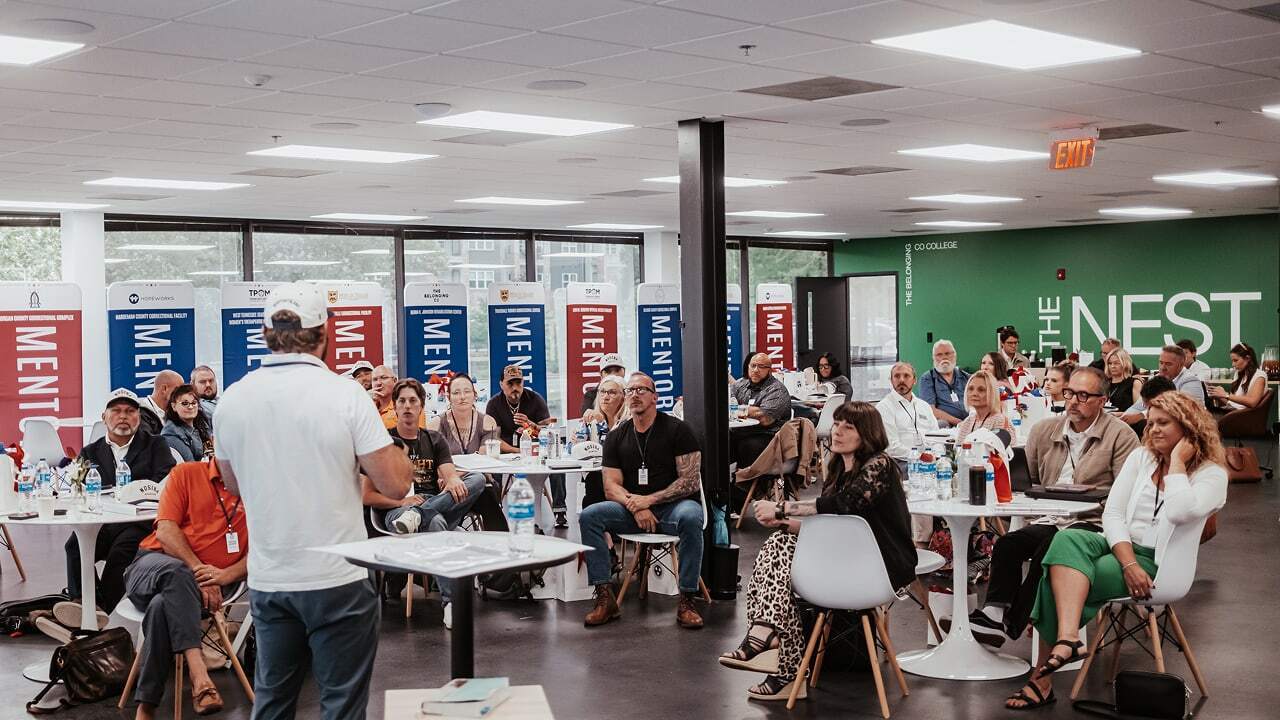
From Memphis to Mountain City, VMI serves men and women in 14 Tennessee Department of Correction facilities. Wherever you are in the state, there's likely a facility — and a mentor team — within driving distance.
East Tennessee
Mountains & Foothills
Middle Tennessee
Heartland & Capital
West Tennessee
River City & Delta
"Wherever you live in Tennessee, there's likely a facility within an hour's drive. The next step is simple: find yours."
04 · The Role
What being a mentor actually looks like.
Hollywood gets this wrong. Real mentorship is quiet, consistent, and unglamorous. Here’s what to expect.
You meet 1-on-1, inside the facility
Most visits are in a designated visitation or program room. You’re never alone with your mentee in unsupervised areas.
Once a month, two hours each
The standard meeting is two hours, typically scheduled from 5–7 PM on a weekday evening to accommodate working schedules.
You commit to at least 18 months
12 months meeting in the facility, followed by 6 months of continued contact after your mentee’s release. Consistency through the transition is what makes this work.
You’ll be equipped with proven tools
You’ll be trained in frameworks like the Science of Hope, which you’ll use to help your mentee identify their goals and build clear pathways toward them. All of this is covered in training — you’ll be well equipped before your first visit.
We support you the whole way
You’ll have regular check-ins with your local support team and a dedicated coordinator. You’ll also have the VMI native app on your phone — where you can ask other mentors questions and access a built-in resource guide for whatever situation comes up.
The relationship continues post-release
For the 6 months after your mentee is released, you’ll touch base at least once a month. This is the period where outside support matters most — and where the relationship you’ve built becomes a lifeline.
05 · The Journey
From "I'm in" to first handshake — about 2 to 4 weeks.
Becoming a mentor isn't instant — it shouldn't be. Once you find your facility and apply, here's the path you'll walk with your local Implementation Partner.
Apply
Select interview date + complete application. Takes ~10 minutes.
Background Check
You’ll get an email after applying with a TDOC background check form to complete.
Interview
30-min conversation with our team.
Training
About 2 hours, all done virtually, at your own pace.
Match
We pair you thoughtfully based on goals and personality.
First Visit
You meet your mentee. The work begins.
06 · The Honest Truth
Things people worry about — answered plainly.
“Will I be safe?”
Yes. You'll be in a supervised environment with trained correctional staff present. Mentors visit in designated program rooms, never in housing units. Across all 14 facilities, VMI has had zero safety incidents involving mentors.
“I have no experience with the justice system.”
Most of our mentors don't either. Training covers everything: facility protocols, what to expect, communication skills, trauma-informed approaches, and how to handle hard conversations. You'll be ready.
“What if I have a record myself?”
Many of our most effective mentors do. TDOC has specific guidelines, and your local team will work with applicants individually. A record doesn't automatically disqualify you — apply and discuss any concerns directly.
“What if I have a loved one who's incarcerated?”
That's often a strength, not a barrier. Lived experience with the system makes for empathetic mentors. We just ask that your mentor relationship be separate from your personal one — different facility, no overlap.
“What if I can't continue?”
Life happens. We ask that you give your local team as much notice as possible so the transition is thoughtful. We never want a mentee to feel abandoned, but we also know commitments change.
“How much will this cost me?”
There are no fees and no required materials — just your time and travel to the facility. Mileage and other expenses are not reimbursed, so factor your drive into the commitment when you decide.
07 · In Their Words
From the mentors and mentees themselves.
Take a few minutes to watch the powerful story of Ginger and Elaine
Ginger & Elaine
A Message From the Governor
“This is the kind of work that changes Tennessee.”
Your work is critically important in ensuring that those who leave our prisons have the tools they need for success.
In partnership with
- Governor’s Faith-Based and Community Initiative
- Tennessee Department of Correction
- 9 Implementation Partners
With Support From


08 · Begin
Ready? Find your facility.
Each facility is run by a different local team. Enter your ZIP code or address below, and we'll show you every Tennessee correctional facility within 60 miles where you're eligible to mentor — sorted by distance.
Step One:
Find a prison near you where you can mentor.
Enter your ZIP code or address and select your gender. We'll show every Tennessee correctional facility within 60 miles where you're eligible to mentor, sorted by distance.
Step Two:
Locations near you where you can mentor.
There are no facilities in a 60 mile radius.
.png?width=450&height=1080&name=Untitled%20design%20(53).png)

10 · Questions
Frequently asked, thoroughly answered.
The best way to partner with us is to submit your information with us via the contact form.
Regular TDOC volunteers may lead Bible studies, recovery groups, or classes — typically with rotating groups of inmates. VMI is one-to-one and long-term: you're matched with a single mentee for at least 18 months, including the critical 6 months after their release. The framework, training, and continuity are what make it different.
No. VMI is an in-person mentorship program, and the relationship is built through your monthly visits inside the facility. We don't supplement with letters or video calls between sessions — what makes this work is showing up consistently, in person, every month.
TDOC requires a state and federal criminal background check for all volunteers entering a facility. The process is straightforward — your local Implementation Partner provides the forms and walks you through it. Most checks come back in 1–2 weeks.
Active warrants, certain recent felony convictions, or any current relationship with someone incarcerated at the facility you'd be assigned to. Past records are reviewed case-by-case — we encourage you to apply and discuss any concerns with your local team directly.
VMI works with TDOC to ensure mentees are not transferred during the active mentoring period. If for some reason your mentee is transferred, your local team will address it on a case-by-case basis. If they are released, you'll continue with them through the 6-month post-release phase.
Yes — TDOC has specific guidelines for attire, and these will all be covered during training. As for what to bring: you'll receive a TDOC VMI badge, which will be the only item you bring into the facility with you.
Your local coordinator matches thoughtfully based on goals, communication style, and shared interests when possible — but not necessarily demographics. Many of the strongest matches come from differences. The coordinator works with both you and your potential mentee to find a good fit.
Absolutely. Each person will need to fill out their own application, and your local team will do their best to ensure your group is placed at the same facility — assuming the genders match the facility population.
Through the VMI native app, you'll have full access to other mentors at your facility, as well as direct support from your local Implementation Partner — who works in close coordination with the Governor's Faith-Based and Community Initiative and the Tennessee Department of Correction. You're never doing this alone.
No. VMI is a fully volunteer program — there are no fees to participate, but mileage and other expenses are not reimbursed. Your time and travel are your contribution.
You can absolutely be both a TDOC volunteer and a VMI mentor — the two roles aren't in conflict. You will, however, need to complete the separate VMI training. The standard TDOC volunteer training does not cover the mentorship-specific tools and frameworks (like the Science of Hope) that mentors use, so the VMI training is required for everyone joining the program.
Each of the 14 facilities is run by a community-based nonprofit — your local Implementation Partner. When you find your facility above, you'll be taken to that team's page, where you can read about them, meet your coordinator, and apply directly with them.
Yes. You'll be in a supervised environment with trained correctional staff present. Mentors visit in designated program rooms, never in housing units. Across all 14 facilities, VMI has had zero safety incidents involving mentors.
Many of our most effective mentors do. TDOC has specific guidelines, and your local team will work with applicants individually. A record doesn't automatically disqualify you — apply and discuss any concerns directly.
Life happens. We ask that you give your local team as much notice as possible so the transition is thoughtful. We never want a mentee to feel abandoned, but we also know commitments change.
Most of our mentors don't either. Training covers everything: facility protocols, what to expect, communication skills, trauma-informed approaches, and how to handle hard conversations. You'll be ready.
That's often a strength, not a barrier. Lived experience with the system makes for empathetic mentors. We just ask that your mentor relationship be separate from your personal one — different facility, no overlap.
There are no fees and no required materials — just your time and travel to the facility. Mileage and other expenses are not reimbursed, so factor your drive into the commitment when you decide.
Your Move
Somewhere in Tennessee, a person is waiting for someone like you to show up.
Not because you're an expert. Not because you've done this before. Just because you're willing.
Find Your Facility